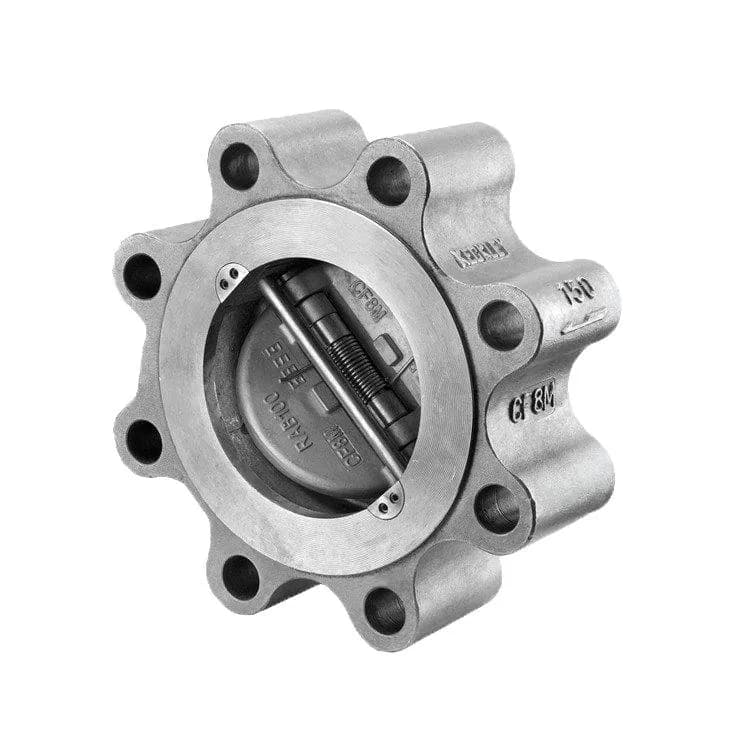
Hastelloy C276/B3 Dual Plate Lug Type Check Valve
High Performance • Durable • Leak Proof
Hastelloy C276/B3 Dual Plate Lug Type Check Valve Manufacturer in Africa for corrosion-resistant backflow prevention.
Technical Specifications
Key Features & Applications
Hastelloy C276/B3 Dual Plate Lug Type Check Valve Manufacturer in Africa
Pump discharge lines carrying acids or aggressive chemicals need a check valve that responds quickly without adding unnecessary face-to-face length. African Valve is a leading Hastelloy C276/B3 Dual Plate Lug Type Check Valve Manufacturer in Africa, supplying South Africa, Nigeria, Egypt, Angola, other African regions and export projects.
Dual Plate Closing Action
The valve uses two semicircular plates mounted around a central hinge pin. Forward flow opens the plates, while torsion springs begin moving them toward the seat as velocity falls. Because each plate is lighter and travels a shorter distance than a conventional swing disc, closure can begin earlier during flow reversal.
This arrangement can reduce valve slam, but it does not remove all surge risk. Pump shutdown time, line length, fluid velocity and system inertia still influence pressure transients.
Why Use a Lug Body?
Threaded lugs are arranged around the valve body so each pipeline flange can be bolted separately. This assists alignment and provides a more controlled connection than a plain wafer body.
A lug configuration should not automatically be assumed suitable for one-sided pressure retention. That condition requires a documented pressure rating from the manufacturer.
C276 and B3 Internal Materials
C276 suits many mixed chemical and chloride-bearing duties. B3 is used mainly for reducing-acid service and requires careful review where oxidising contaminants may be present.
The body, plates, hinge pin, springs, retainers and seat components should use the selected alloy or a compatible corrosion-resistant material. Springs and pins are particularly important because they remain exposed to the process and operate under repeated movement.
Metal seats suit higher temperatures and abrasive media. PTFE or resilient seats may provide lower leakage in clean chemical service. Seat selection also affects cracking pressure and closing response.
Technical Specifications
Size Range: DN50 to DN900
Pressure Ratings: ASME Class 150 to Class 600
Design Standards: API 594 and ASME B16.34 where applicable
Testing Standard: API 598
End Connections: Lug pattern to specified flange drilling
Operation: Automatic, flow actuated
Body Materials: Hastelloy C276 or Hastelloy B3
Plate Design: Dual spring-assisted plates
Seat Options: Metal, PTFE or resilient seat
Installation: Horizontal or vertical upward flow when approved
Flow and Sizing Considerations
A dual plate check valve should be sized from operating flow rather than pipe diameter alone. Low velocity may prevent the plates from reaching a stable open position, leading to flutter, spring fatigue or seat impact.
The required cracking pressure, minimum flow and allowable pressure drop should be included in the enquiry. Spring torque may need adjustment for vertical installation.
Applications
The valve is used on chemical-transfer pumps, acid-circulation systems, scrubber lines, offshore injection systems and pollution-control equipment. C276 is generally selected for mixed corrosive service, while B3 is reserved for reducing environments with controlled oxidising contamination.
PMI confirms the body, plates, hinge pin and springs. Dimensional inspection checks the lug drilling, face-to-face length and plate clearance. Hydrostatic shell and seat testing verify pressure containment and leakage performance. Spring movement and plate travel are also checked before dispatch. African Valve supplies C276 and B3 dual plate lug check valves for compact chemical systems. The RFQ should include fluid composition, flow range, pressure, temperature, orientation, flange standard, cracking pressure and seat requirement.Manufacturing and Inspection
Check Valve Supply Across Africa