Butterfly valves are used across Africa in water networks, wastewater plants, mining operations, oil & gas facilities, power stations, desalination systems and other industrial processes. But the operating conditions in these systems can be very different. A valve used on a municipal water line does not face the same pressure, temperature or sealing demands as one installed on a steam or hydrocarbon service.
This is where the choice between double offset and triple eccentric butterfly valves becomes important. Both designs reduce the constant disc-to-seat rubbing associated with concentric butterfly valves, but they do it in different ways and are suited to different duties.
What Is a Double Offset Butterfly Valve?
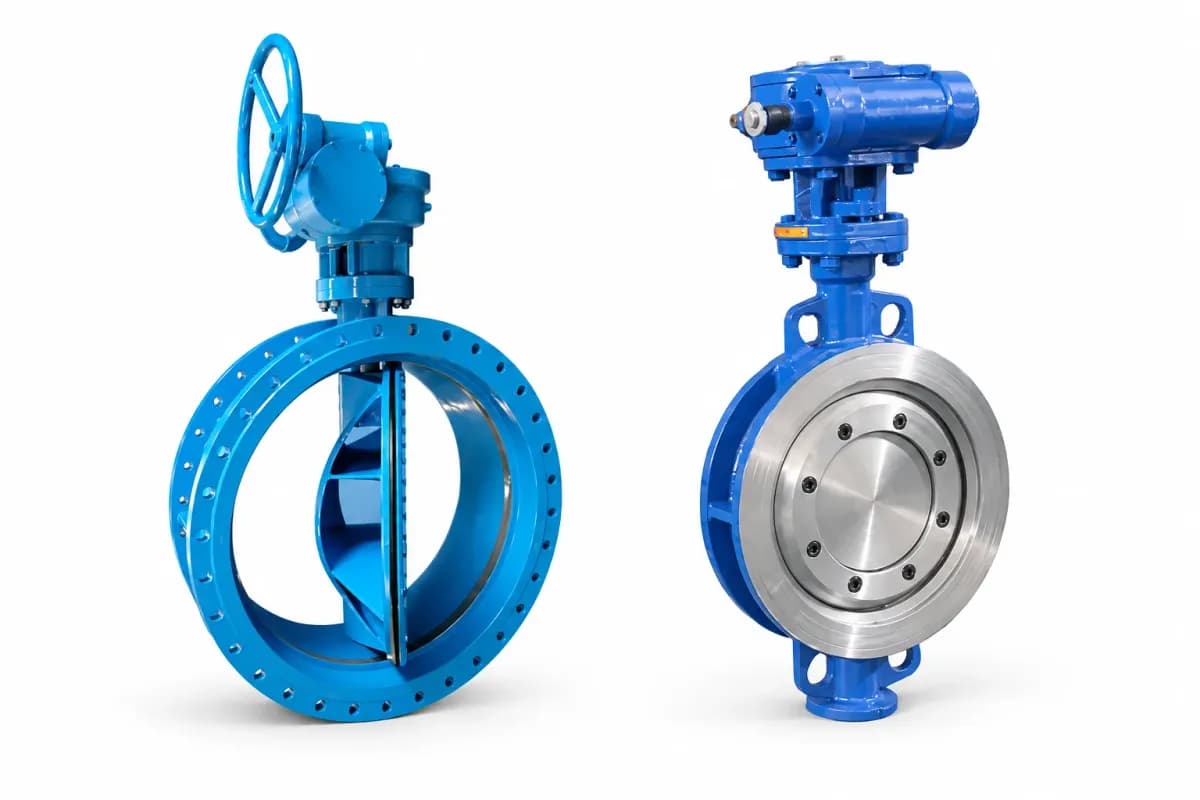
A double offset butterfly valve, also called a double eccentric butterfly valve, uses two offsets in the position of the shaft and disc.
The first offset places the shaft behind the disc centreline. The second moves it away from the centreline of the sealing surface. Together, these offsets allow the disc to move away from the seat shortly after the valve begins to open.
As a result, there is less rubbing between the disc and seat compared with a concentric butterfly valve. This can reduce operating torque and seat wear, which is particularly useful in valves that operate frequently.
Typical applications include:
|
|
What Is a Triple Eccentric Butterfly Valve?
A triple eccentric butterfly valve, also known as a triple offset butterfly valve, adds a third offset to the double offset arrangement.
This third offset is part of the sealing geometry itself. It creates an angled or conical sealing surface, allowing the disc and seat to remain separated through most of the valve stroke. Contact occurs mainly as the valve reaches the fully closed position.
This arrangement greatly reduces sliding friction and makes metal-to-metal sealing possible.
Triple eccentric valves are therefore commonly considered for:
|
|
Triple Eccentric vs Double Offset Butterfly Valves: Technical Comparison
Selection Parameter | Double Offset Butterfly Valve | Triple Eccentric Butterfly Valve |
Alternative Name | Double Eccentric | Triple Offset |
Offset Geometry | Two shaft offsets | Two shaft offsets + third sealing offset |
Typical Seat | Resilient / PTFE / application-specific | Metal-to-metal / laminated metal |
Disc-Seat Contact | Reduced during rotation | Minimal through most of the stroke |
Typical Pressure Range | PN10–PN40 / Class 150–300 | Class 150–900 |
Temperature Capability | Mainly limited by seat material | Better suited to elevated temperatures |
Thermal Cycling | Suitable for moderate service | Better suited to demanding thermal cycling |
Actuation | Gear / Pneumatic / Electric | Gear / Pneumatic / Electric |
Typical Duty | Water, wastewater, mining utilities | Oil & gas, refinery, steam, power, petrochemical |
Double Offset Valves in African Water Infrastructure
Water infrastructure across Africa includes transmission pipelines, treatment plants, reservoirs, pumping stations, desalination facilities and industrial water systems.
Double offset butterfly valves work well in many of these applications because they offer a compact design for larger pipeline sizes and lower disc-to-seat friction than concentric valves.
Water chemistry also matters. Factors such as chloride concentration, salinity, pH, dissolved oxygen, suspended solids and treatment chemicals can influence material selection.
For coastal or desalination projects, stainless steel, duplex or super duplex materials may be considered for suitable components where additional corrosion resistance is needed.
Mining Applications
Mining operations in countries such as South Africa, Zambia, the Democratic Republic of the Congo, Ghana and Botswana rely heavily on process-water and utility networks.
Butterfly valves may be used in:
The important point is that mining service is not always clean-water service. Abrasive solids, suspended particles and corrosive media can change the valve requirements significantly.
Triple Eccentric Valves for Oil & Gas
Oil and gas facilities in Nigeria, Algeria, Angola and Egypt often involve hydrocarbon, gas and elevated-temperature process duties.
Triple eccentric butterfly valves may be considered for:
Power Generation Applications
The choice between Triple Eccentric vs Double Offset Butterfly Valves in power-generation systems depends on whether the service is water-based or high-temperature
Double offset valves may be suitable for:
- Cooling water
- Circulating water
- Service water
- Utility lines
- Large-diameter water systems
Triple eccentric valves may be considered for:
- Steam isolation
- High-temperature process lines
- Hot gas
- Thermal systems
The better choice depends on the actual pressure and temperature conditions, not simply on the fact that the valve is being installed in a power plant.
Materials and Temperature Selection
Seat construction plays a major role in determining temperature capability.
Double offset valves often use resilient or polymer-based seats, which means their temperature limit can be controlled by the seat material. Triple eccentric valves generally use metal or laminated metal seating, making them better suited to elevated-temperature and thermal-cycling duties.
Common construction materials include:
- Carbon steel
- Stainless steel
- Duplex stainless steel
- Super duplex stainless steel
- Nickel alloys
For coastal, desalination or chloride-bearing applications, material selection should be reviewed together with the process chemistry, temperature and pressure.
Pressure, Actuation and Testing
Before selecting either valve type, engineers should review the design pressure, maximum differential pressure, operating temperature, flow velocity and required leakage performance.
Differential pressure has a direct effect on disc torque, so actuator sizing should be based on the actual operating conditions rather than the nominal pipe size alone.
Butterfly valves may be designed according to API 609, with testing carried out to API 598 or ISO 5208. Fire-safe designs may require API 607, while sour-service applications can require NACE MR0175 / ISO 15156, depending on the project.
Selection for African Projects
| Application | Main Selection Consideration |
|---|---|
| Water & Wastewater | Double offset design, large diameter, seat compatibility |
| Mining | Abrasion, solids concentration, corrosion and pressure |
| Oil & Gas | Triple eccentric design, metal seating, fire-safe requirements |
| Power Generation | Double offset for water duties; triple eccentric for steam and high-temperature service |
| Desalination | Chloride resistance and corrosion-resistant materials |
| Industrial Processing | Pressure, temperature, media compatibility and leakage requirement |
African Valve for Double Offset and Triple Eccentric Butterfly Valves
African Valve supplies double offset Butterfly valve and triple eccentric butterfly valves for water, mining, oil & gas, power, petrochemical, desalination and industrial projects across Africa.
Valve configurations can be selected according to the required size, pressure class, operating temperature, body and disc material, seat construction, end connection and actuation.
Related Topics