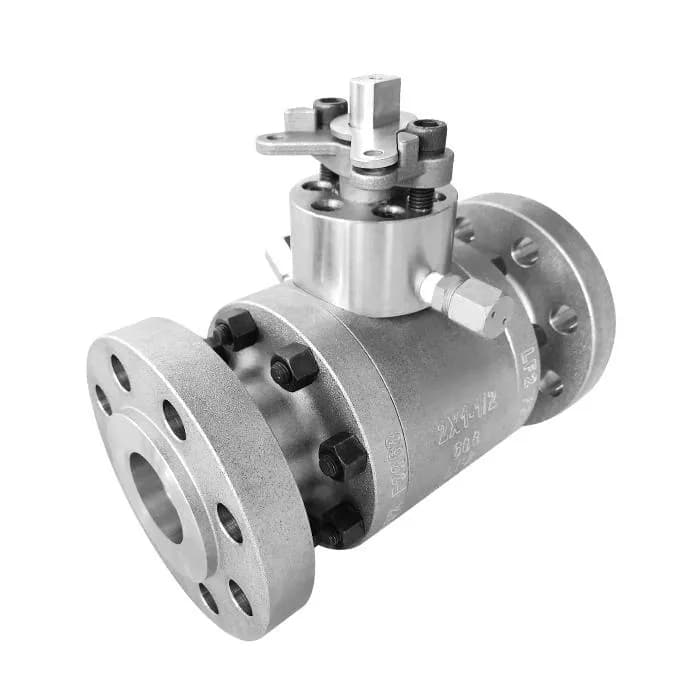
Hastelloy C276/B3 Floating Ball Valve
High Performance • Durable • Leak Proof
Hastelloy C276/B3 Floating Ball Valve Manufacturer in Africa for corrosion-resistant flow control.
Technical Specifications
Key Features & Applications
Hastelloy C276/B3 Floating Ball Valve Manufacturer in Africa
Floating ball valves provide compact isolation in smaller sizes, but corrosive service places additional demands on the body, ball, stem and seat retainers. African Valve is a prominent Hastelloy C276/B3 Floating Ball Valve Manufacturer in Africa, supplying South Africa, Nigeria, Egypt, Angola, other African countries and selected international projects.
How the Floating Ball Seals
The ball is supported by two seats rather than fixed between trunnions. When the valve closes, line pressure moves the ball slightly toward the downstream seat. This pressure-assisted movement increases contact at the seat and creates shutoff.The design is compact and works well in small and medium sizes. As valve diameter and differential pressure increase, seat load and operating torque also increase. Larger or higher-pressure applications may therefore be better suited to a trunnion-mounted ball valve.
Selecting C276 or B3
C276 provides broad resistance in many mixed chemical and chloride-bearing services. B3 is intended mainly for reducing acids and should be selected only after checking oxidising contaminants, dissolved oxygen and process impurities.The material decision must include normal operation, startup, shutdown and cleaning. A cleaning chemical used for only a few hours can still attack an alloy that performs well during normal production.
Internal Construction
The body, ball and stem should use the specified C276 or B3 grade, or another material proven compatible with the service. Springs, anti-static components, gland parts and seat retainers can become weak points if they are made from lower-alloy materials.Soft-seat options include PTFE, RPTFE and PEEK. Metal seats are considered for high temperatures, abrasive particles or frequent cycling. Depending on the design, cavity-pressure relief, fire-tested construction and anti-static protection may be included.
Technical Specifications
Size Range: DN15 to DN200
Pressure Ratings: ASME Class 150 to Class 600
Design Standards: API 608, ISO 17292 and ASME B16.34
Testing Standard: API 598
End Connections: Flanged, threaded, socket weld or butt weld
Operation: Lever, gearbox, pneumatic actuator or electric actuator
Body Materials: Hastelloy C276 or Hastelloy B3
Ball Design: Floating
Bore Type: Full bore or reduced bore
Seat Options: PTFE, RPTFE, PEEK or metal seat
Actuator Mounting: ISO 5211
Operating Characteristics
Quarter-turn movement gives fast isolation. In a full-bore valve, the flow path remains comparatively clear when open. The floating arrangement provides pressure-assisted seating without a separate trunnion system, which keeps the valve compact.
Actuator sizing should consider maximum differential pressure, seat friction, temperature and expected deposits. Selecting the actuator only from nominal valve size may result in insufficient closing torque.
Applications
C276 floating ball valves are used in chlorine processing, mixed-acid transfer, chemical injection, scrubber systems and corrosive waste lines. B3 versions are considered for selected hydrochloric, sulphuric and other reducing-acid services after process chemistry has been reviewed.
Material certificates and PMI verify the selected alloy. Dimensional inspection confirms the bore, end connections and stem interface. Shell-pressure testing checks body integrity, while seat testing confirms shutoff. Anti-static continuity and operating torque can be checked when specified. African Valve supplies Hastelloy C276 and B3 floating ball valves for industrial projects across Africa. Final selection requires fluid chemistry, pressure, temperature, bore, seat material, end connection, leakage requirement and operating method.Inspection and Testing
Supply for Chemical Installations