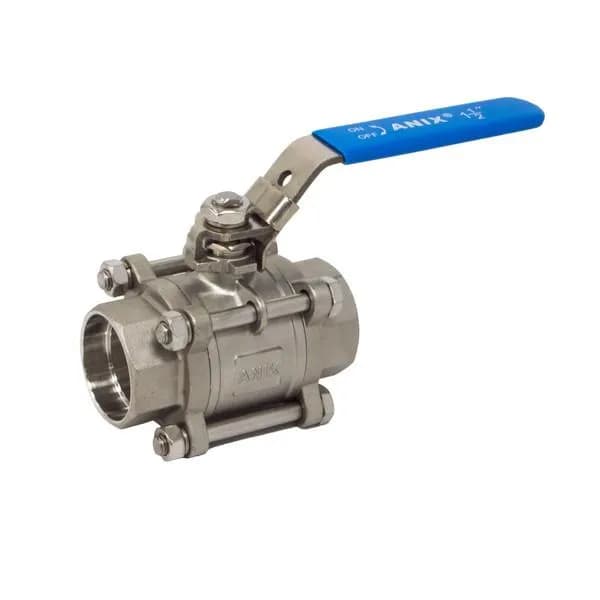
Super Duplex 2 Piece Ball Valve
High Performance • Durable • Leak Proof
Super Duplex 2 Piece Ball Valve Manufacturer in Africa for corrosion-resistant industrial flow control.
Technical Specifications
Key Features & Applications
Super Duplex 2 Piece Ball Valve Manufacturer in Africa
Seawater, concentrated brine and produced-water lines can attack ordinary stainless-steel valves at the seat pockets, stem bore and body cavity. A two-piece ball valve in Super Duplex is used where compact construction, quarter-turn isolation and stronger chloride resistance are required. African Valve is a prominent Super Duplex 2 Piece Ball Valve Manufacturer in Africa, supplying South Africa, Nigeria, Egypt, Angola, other African countries and selected export markets.
Why Super Duplex Is Selected
Super Duplex stainless steel combines a ferritic-austenitic structure with high chromium, molybdenum and nitrogen. Cast pressure parts are commonly produced in ASTM A995 Grade 5A, while forged components may use ASTM A182 F53 or F55. These grades provide higher strength and stronger resistance to pitting, crevice corrosion and chloride stress-corrosion cracking than standard duplex F51.
Material grade alone does not determine service life. Heat treatment, ferrite balance, welding, surface condition, temperature and stagnant crevices all affect corrosion performance. Warm seawater and chemical mixtures should be reviewed from operating data rather than chloride concentration alone.
Two-Piece Body and Ball Operation
The valve is formed from a main body and an end section that retain the ball, seats and stem assembly. This arrangement is compact, although internal maintenance normally requires valve removal from the pipeline.
A quarter-turn of the stem rotates the ball between the open and closed positions. Full-bore construction keeps the port close to the pipe bore and helps reduce pressure loss. Reduced-bore designs provide a smaller body where a narrower flow passage is acceptable. The valve is intended mainly for isolation; partial opening can expose the seats to erosion.
Trim, Stem and Seat Selection
The body may be cast in ASTM A995 Grade 5A or manufactured from forged F53/F55 material according to size and pressure class. The ball, stem, gland parts and seat retainers should use compatible Super Duplex grades or another qualified corrosion-resistant alloy. Lower-alloy internal parts can become the first corrosion point even when the body remains sound.
PTFE and RPTFE seats suit many clean water and chemical services. PEEK may be used where pressure or temperature requires greater mechanical strength. Metal seats are considered for abrasive particles, elevated temperature or frequent cycling. Optional arrangements include a blowout-resistant stem, anti-static device, cavity relief, fire-tested construction and ISO 5211 mounting.
Technical Specifications
Size Range: DN15 to DN300
Pressure Ratings: ASME Class 150 to Class 900
Design Standards: API 608, ISO 17292 and ASME B16.34
Testing Standard: API 598
End Connections: Flanged RF/RTJ, threaded, socket weld or butt weld
Operation: Lever, gearbox, pneumatic actuator or electric actuator
Body Materials: ASTM A995 Grade 5A, ASTM A182 F53 or ASTM A182 F55
Body Construction: Two-piece
Bore Type: Full bore or reduced bore
Seat Options: PTFE, RPTFE, PEEK or metal seat
Performance in Severe Chloride Service
Quarter-turn operation provides fast shutoff, while the straight ball port keeps flow restriction comparatively low when fully open. Super Duplex strength can support compact pressure-containing parts where the design standard permits. Actuator torque should still be calculated from differential pressure, seat material and operating temperature.
Industrial Applications
Typical duties include seawater injection, desalination high-pressure circuits, produced-water treatment, offshore firewater, brine transfer, pulp and paper processing and chloride-bearing chemical systems. Sour oil and gas service may require NACE MR0175/ISO 15156 review in addition to the alloy specification.
Manufacturing and Inspection
Material Test Certificates are checked against the body and trim heat numbers. PMI, ferrite measurement, heat-treatment review and NDT may be included according to the project. Dimensional inspection confirms body alignment, ball-port position and end connections. Hydrostatic shell and seat-leakage testing verify containment and shutoff before dispatch.
Supply for African Projects African Valve supplies Super Duplex two-piece ball valves for marine, offshore, water and process installations across Africa. The enquiry should state fluid chemistry, chlorides, pressure, temperature, bore, seat material, end connections, actuator and inspection requirements.