
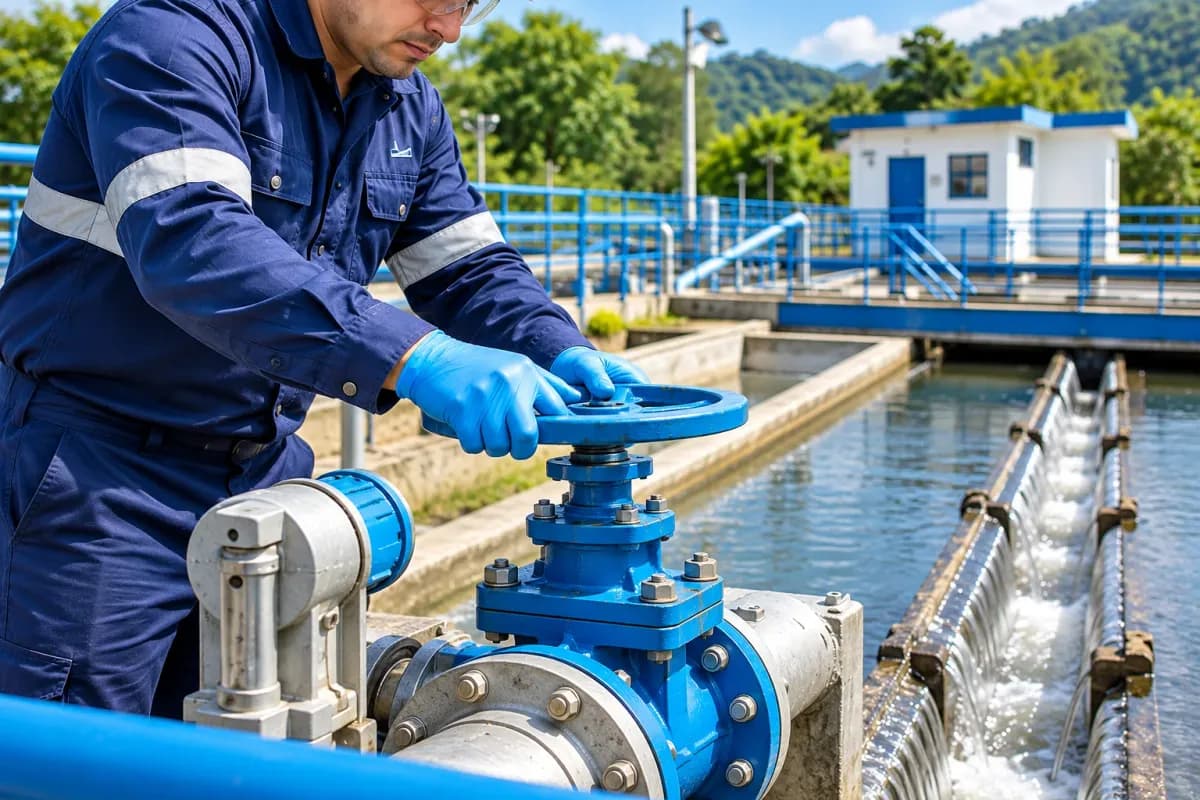
Water and wastewater infrastructure across Africa includes municipal treatment plants, large transmission pipelines, mining-water systems, desalination facilities and industrial wastewater plants. These applications expose valves to significantly different operating conditions, making valve selection an engineering decision rather than simply matching valve size to pipe diameter.
The correct valve must be selected according to service medium, pressure, flow velocity, solids content, temperature, corrosion, sealing requirements, operating frequency and maintenance conditions. Coastal environments, abrasive solids, variable water chemistry and remote installations can all affect valve performance and service life.
Understand the Service Medium
Service | Main Technical Considerations | Selection Focus |
Raw water | Turbidity, sediment, suspended solids | Abrasion resistance and reliable isolation |
Potable water | Water quality and material compatibility | Approved wetted materials |
Wastewater | Grit, fibres, rags, grease and solids | Solids handling and sealing |
Sludge | High solids concentration and viscosity | Low clogging risk and operating torque |
Reclaimed water | Variable chemistry and suspended solids | Corrosion resistance |
Seawater | High chloride concentration | Duplex/super duplex or suitable alloys |
Treatment chemicals | Concentration, temperature and compatibility | Suitable body and trim materials |
Wastewater and sludge generally require more careful valve selection than clean-water service because solids can accumulate around seats or internal cavities and increase operating torque.
Selection of the Valve
Application | Typical Valve | Key Requirement |
Pipeline isolation | Gate / Butterfly | Reliable shut-off |
Large-diameter isolation | Compact construction | |
Pump discharge | Check | Reverse-flow prevention |
Flow regulation | Application-specific control valve | Stable throttling performance |
Pipeline air management | Air-release / air-vacuum valve | Air removal and admission |
Wastewater isolation | Gate / suitable wastewater valve | Solids tolerance |
Chemical isolation | Chemical compatibility |
Gate valves provide a relatively unobstructed passage when fully open, while butterfly valves offer compact construction and are particularly useful on larger pipelines where valve weight and installation space are important. Check valves require separate consideration because their closing characteristics can affect reverse flow.
Consider Solids and Abrasion
Wastewater can contain grit, fibres, rags, organic matter and suspended solids, while mining-water applications may contain abrasive mineral particles. These conditions can cause seat wear, internal erosion, increased operating torque and incomplete closure.
Valve selection should therefore consider:
Internal cavity geometry
Flow passage
Seat arrangement
Abrasion resistance
Solids accumulation
Operating torque
Cleaning and maintenance requirements
Sludge service requires additional consideration because increased solids concentration can increase viscosity and make valve operation more demanding. Evaluate Pressure, Velocity and Water Hammer. Valve selection must account for both normal and transient operating conditions. Pump start-up, shutdown, power failures and rapid valve closure can generate pressure surges and water hammer.
Important design parameters include:
Maximum operating pressure
Design pressure
Differential pressure
Flow velocity
Pump characteristics
Pipeline elevation
Surge pressure
Valve closing time
A valve should not be selected solely from the normal operating pressure. The maximum transient pressure must also be considered when determining the required pressure class. For pump discharge and other reverse-flow protection duties, check-valve selection should consider closing dynamics as well as pressure and flow conditions.
Select Materials for the African Environment
Material selection should reflect water chemistry, chloride exposure, temperature, corrosion and mechanical loading.
Material | Typical Application Consideration |
Ductile iron ASTM A536 | General water and wastewater service |
Carbon steel ASTM A216 WCB | Higher-pressure or project-specific applications |
Stainless steel 304/316/316L | Corrosive water and chemical environments |
Duplex UNS S31803/S32205 | Chloride-bearing and demanding services |
Super duplex UNS S32750/S32760 | Seawater and severe chloride exposure |
Nickel alloys | Highly corrosive or chemically aggressive service |
Protective coatings | Internal and external corrosion protection |
Coastal installations in South Africa, Mozambique, Egypt, Algeria and Nigeria may experience increased chloride exposure. Desalination plants require particular attention to pitting, crevice corrosion and material compatibility. For waterworks equipment, protective internal coatings can also be important.
Select Materials for the African Environment
Seat selection directly affects leakage performance, operating torque and service life.
The sealing system should be evaluated against:
Fluid chemistry
Disinfectant exposure
Temperature
Differential pressure
Operating frequency
Abrasive solids
Required leakage performance
Potable-water applications additionally require compliance with applicable drinking-water material requirements and project specifications.
Applicable Valve Standards for African Projects
African Valve projects may specify AWWA, API, DIN EN and ISO standards based on industry and service. Key standards include AWWA C500, C504, C508, C509, C512, C516, C517, C519 and C520; API 594, 598, 600, 602, 608 and 609; DIN EN 593, EN 1074 and EN 12266; and ISO 5208, 5752, 5211 and 10497 for valve design, dimensions, testing and fire-safe requirements.
Actuation and Maintenance
Manual operation can be suitable for accessible valves operated infrequently. Large, remote or frequently operated valves may require electric or pneumatic actuation, depending on the control philosophy. Actuator sizing should consider valve torque, maximum differential pressure, operating conditions and an appropriate safety margin. Maintenance access is particularly important for African infrastructure. Remote mining facilities, pumping stations and distributed municipal networks can present challenges for specialist maintenance and spare-parts supply. Valve selection should therefore consider accessibility, installation space, actuator or gearbox clearance, spare parts, inspection requirements and isolation arrangements.
Valve Selection for African Water Infrastructure
African water projects range from municipal treatment and wastewater pumping to mining-water systems, desalination plants and long-distance transmission pipelines. Each application presents different requirements for pressure, corrosion resistance, solids handling and maintenance. African Valve supplies gate, globe, check, ball and butterfly valves for industrial and infrastructure applications, with selection based on the required valve function, pressure class, fluid characteristics, material grade, corrosion environment and operating conditions.
Related Topics