The chemical, mining, electricity, and water treatment industries in South Africa all make exensive use of control valves to manage flow, pressure, temperature, and liquid level. Automated valve systems are used for process control, water treatment, steam, utilities, and other continuous plant services in facilities like Sasol's Secunda and Sasolburg operations as well as large power projects like Medupi.
It takes more than just matching pipe size to choose the proper control valve. To ensure stable control in minimum, normal, and maximum operating circumstances, engineers must assess Cv, pressure drop, valve authority, flow characteristics, cavitation, flashing, trim design, and actuation.
Control Valve Selection Starts with Process Data
The real process conditions are the first step in accurate control valve sizing. Because upstream pressure, downstream pressure, and available differential pressure can fluctuate throughout system operation, minimum, normal, and maximum flow situations should be examined.
Parameter | Information Required |
Process fluid | Liquid, gas, steam or multiphase |
Flow rate | Minimum, normal and maximum |
Pressure | Upstream and downstream pressure at each flow case |
Temperature | Minimum, normal and maximum |
Fluid properties | Density or specific gravity, vapour pressure, viscosity, molecular weight and compressibility where applicable |
Valve requirements | Function, pipe size, connection, failure position and control signal |
Gas and steam sizing requires additional attention to compressibility, pressure, temperature and the possibility of choked flow.
Understanding Cv in Control Valve Sizing
The flow capacity of a valve is indicated by the valve flow coefficient, or Cv.
The number of US gallons of water that will flow through a valve per minute with a pressure drop of 1 psi under particular reference conditions is the standard definition of Cv for liquid service.
More flow capacity is provided with a greater CV, but larger isn't necessarily preferable.
Because tiny movements can result in significant changes in flow, an oversized control valve may spend a significant portion of its operational time near the seat. As a result, seat and trim wear may increase and process control may become unstable.
A valve that is too small could not be able to pass the necessary maximum flow.
Pressure Drop Across a Control Valve
The pressure drop across a control valve is the difference between the upstream and downstream pressure.
This differential pressure drives flow through the valve trim.
Too little pressure drop can reduce the valve’s ability to influence the process. Excessive pressure drop can increase velocity and contribute to noise, vibration, erosion, cavitation or flashing.
Valve authority describes how much of the total system pressure drop occurs across the control valve at a given operating condition. Low valve authority can make accurate control more difficult because changes elsewhere in the piping system have a greater influence on flow.
Pressure drop should therefore be checked at each operating case rather than using one fixed value for all conditions.
Linear vs Equal Percentage Flow Characteristics
The selected control valve flow characteristic influences how flow changes as the valve moves.
Characteristic | Behaviour | Typical Consideration |
Linear | Equal changes in valve travel produce approximately equal changes in flow at constant differential pressure | Useful where valve pressure drop remains relatively constant |
Equal Percentage | Equal changes in travel produce equal percentage changes in existing flow | Useful where system pressure drop changes significantly with flow |
Quick Opening | Large flow increase occurs during early valve travel | More common in rapid-response or on-off duties |
These are inherent flow characteristics, measured under controlled differential pressure.
Once the valve is installed, the actual response also depends on the pump, piping resistance and other system losses. This is known as the installed flow characteristic.
An equal-percentage control valve, for example, can produce a more linear process response after installation when the pressure drop across the valve decreases as flow increases.
Cavitation, Flashing and Choked Flow
High differential pressure can create additional problems in liquid service.
Cavitation occurs when local pressure inside the valve falls below the liquid vapour pressure, forming vapour bubbles. If the pressure then recovers, those bubbles collapse and can damage the trim and downstream surfaces.
Flashing occurs when the pressure falls below vapour pressure and remains below it downstream, so part of the liquid continues as vapour.
Choked flow occurs when increasing the differential pressure no longer produces the expected increase in flow because the valve has reached a limiting flow condition.
Depending on the service, possible design responses may include staged pressure-reduction trims, hardened materials, modified trim geometry or a different valve location.
Choosing the Control Valve Body and Trim
The valve body style should be selected around the actual process duty.
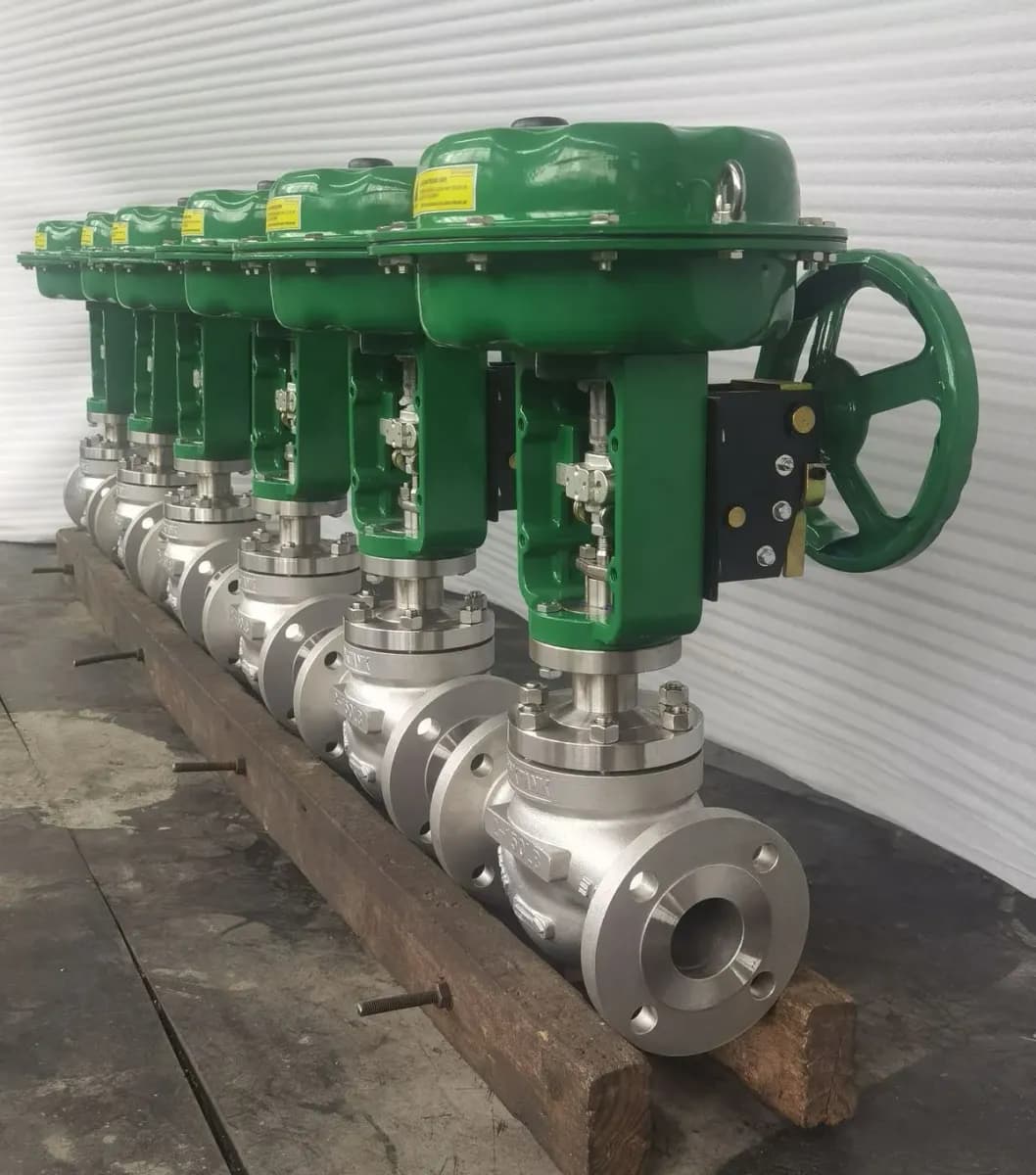
Globe control valves are commonly used for accurate throttling and provide a wide choice of trim designs.
Rotary control valves, including suitable ball and butterfly designs, may be preferred for higher flow capacity, larger line sizes or installations where compact construction is important.
Important selection factors include:
|
|
Body and trim materials may include carbon steel, stainless steel, alloy steel, duplex, super duplex or specialised alloys depending on the process medium.
Pneumatic vs Electric Control Valve Actuation
Pneumatic control valves use instrument air to position the valve. Diaphragm and piston actuators are commonly used, with spring-return designs providing fail-open or fail-closed action where required.
Electric control valves use motor-driven actuators and may suit installations where electrical power is available but instrument air is not.
Actuator selection should consider:
Required thrust or torque Available air pressure or electrical supply Operating time Modulating duty Control signal Positioning accuracy Hazardous-area requirements Fail position
The actuator must be sized for the actual process forces acting on the valve rather than nominal valve size alone.
Control Valve Design and Sizing Standards
Standard | Application |
IEC 60534 series | Industrial-process control valve sizing, flow capacity, testing and performance |
ISA 75 series | Control valve sizing, terminology, testing and related requirements |
Both IEC 60534 and ISA 75 contain multiple parts, so the applicable section depends on whether the requirement relates to sizing, flow capacity, leakage, testing or terminology.
Project specifications may also include additional requirements for pressure ratings, materials, actuators, inspection and testing.
Control Valves for South African Process Industries
South Africa’s process industries use control valves across chemical production, mining, power generation, water treatment and industrial utility systems. Sasol’s Secunda operations include synthetic fuels and chemical production, while Sasolburg remains an integrated chemical manufacturing site with its own electricity and utility systems. Medupi Power Station in Limpopo also represents the type of large power facility where steam, water and other process systems depend on controlled fluid movement.
African Valve supplies pneumatic control valves, electric control valves, globe control valves for industrial applications across South Africa and other African markets.
For technical enquiries, buyers should provide minimum, normal and maximum flow, upstream and downstream pressure, operating temperature, process fluid and relevant properties, pipe size, body material, fail position, control signal, actuator requirement and quantity.
Accurate process data allows the required control valve Cv, pressure drop, flow characteristic, trim design and actuator sizing to be reviewed before specification, reducing the risk of oversized valves, unstable process control and premature trim wear.
Related Topics